segunda-feira, 18 de setembro de 2017

Velhice Bem-Sucedida

Resultado de imagem para desenvolvendo competências pessoais para viver bem a velhice Resultado de imagem para desenvolvendo competências pessoais para viver bem a velhice


É possível viver bem na velhice? A velhice não é uma fase somente de perdas, como algumas pessoas costumam pensar. Existem ganhos também. Mas é preciso estar preparado para perceber e vivenciar isso. Ou melhor, é preciso preparar-se para aproveitar as possibilidades que essa fase pode oferecer. Este livro aborda um método para desenvolver atitudes positivas em relação à própria pessoa e à vida de modo a auxiliar no enfrentamento das perdas e na descoberta das possibilidades de ganhos para aproveitar bem a velhice. A técnica foi projetada para ser utilizada em grupo, com a mediação de um profissional habilitado. Contudo, a leitura do livro pode ser útil a qualquer pessoa que deseje aprimorar o autoconhecimento e aperfeiçoar competências pessoais que favoreçam um desenvolvimento bem-sucedido e, consequentemente, a adaptação plena ao envelhecimento

domingo, 12 de março de 2017

I Simposio de Envelhecimento Humano UFPA

Nos dias 22, 23 e 24 de março será realizado o I Simpósio de Envelhecimento Humano, coordenado pelo Prof. Dr. Janarí da Silva Pedroso e pela Profª. Drª Celina Maria Colino Magalhães.
O evento apresentará um conjunto de estudos e pesquisas sobre os processos de envelhecimento humano em diálogo com as discussões acerca do dinamismo familiar, das relações de cuidados e da evidência de ações violentas. 
Público Alvo: Pesquisadores, educadores, técnicos, estudantes entre outros profissionais e autoridades voltados à Garantia dos Direitos da Pessoa Idosa. 
Local: Auditório Setorial Básico da UFPA.

Inscrições e submissão de trabalho Via E-mail: ladsufpa@gmail.com
Inscrições limitadas: 150 vagas
Envio de trabalhos até o dia 15 de março 2017 Certificados: frequência de 75%

2a Jornada Amapaense de Terapia Cognitivo-comportamental


​PROGRAMAÇÃO 
SEXTA-FEIRA – 17 de março de 2017
14h-15h - Credenciamento
15h-16h - Abertura
                  Palestra “Usos Clínicos da Hipnose” (Prof. Marcilio Lira)
16h-17h - Palestra “Psicofarmacologia e Psicoterapia: os Benefícios do Tratamento Combinado” (Psiquiatra                       Helder Damasceno de Albuquerque)
17h-17h30 - Intervalo
17h30-19h - Exposição de Banners
19h-21h - Palestra Magna “As Habilidades Sociais, Saúde Psicológica e Qualidade de Vida” (Prof. Zilda Del Prette e Prof.                 Almir Del Prette)


SÁBADO – 18 de março de 2017
08h-08h40 - Palestra “Jogo Patológico e seu Tratamento” (Prof. Graça Martins)
08h50h - 09h30 - Palestra "TCC aplicada à reabilitação de capacidade funcional" (Prof. Hilma Khoury)
9h30-10h - Intervalo
10h-11h - Minicurso “O Treinamento de Habilidades Sociais na Prática Clínica” (Prof. Zilda Del Prette e  Prof. Almir Del                       Prette)
11h-12h - Sessão de autógrafos com os Professores Zilda e Almir Del Prette
12h-14h - Intervalo para Almoço
14h-16h - Minicurso “O Treinamento de Habilidades Sociais na Prática Clínica” (Prof. Zilda Del Prette e Prof. Almir Del                       Prette)
16h-16h30 - Intervalo
16h30-17h30 - Minicurso “O Treinamento de Habilidades Sociais na Prática Clínica” (Prof. Zilda Del Prette e Prof. Almir                              Del Prette)
17h30-18h - Encerramento e Entrega das Menções Honrosas as Trabalhos Premiados
Emissão de Certificado de Participação
Carga horária total do evento - 18h

Participação Espcial


sábado, 17 de dezembro de 2016

Velhice e Sexualidade

https://goo.gl/cayTJv#.WFVU8j-r-6E
Manchester,
6
December
2016

Research finds that older people’s sexual problems are being dismissed

sex-seventies-elderly-couple.jpg
Older people’s sexual activity problems and desires are being dismissed by health practitioners due to their age, a new study has suggested.

Research by The University of Manchester’s MICRA (Manchester Institute for Collaborative Research on Ageing) and Manchester Metropolitan University highlighted the obstacles some older couples face in maintaining fulfilling sexual lives, and how they adapt to these barriers.

The study analysed written comments from over a thousand adults aged 50 to 90 who responded to the English Longitudinal Study of Ageing Sexual Health and Relationships questionnaire. Respondents of both sexes emphasised their anxiety at not being taken seriously by health practitioners as they sought to overcome issues affecting their sexual activity, such as a drop in sexual desire or physical difficulties. One man in his eighties reported being refused Viagra for erectile dysfunction on the grounds of cost.

Participants in the study, published in Ageing and Society, cited other elements influencing sexual activity, including health conditions and physical impairment, the evolving status of sex in relationships and mental wellbeing. It was also found that men were more likely to talk about the impact of health conditions on sexual activities, but women were more likely to talk about health-related sexual difficulties in the context of a relationship.

The study recommends that health care practice should positively engage with issues of sexual function and sexual activity to improve the health and wellbeing of older people, particularly in the context of long-term health problems.

“This research further improves our understanding of love and intimacy in later life”, said study co-author David Lee, Research Fellow from The University of Manchester.

“It builds upon empirical findings published in our earlier paper (Sexual health and wellbeing among older men and women in England; Archives of Sexual Behaviour) which described a detailed picture of the sex lives of older men and women. However, this new research uses narrative data to better understand how changing age, health and relationships interrelate to impact sexual health and satisfaction.”
Appreciating individual and personal perspectives around sexuality and sexual health is of paramount importance if we are to improve sexual health services for older people.
Dr David Lee

sexta-feira, 14 de outubro de 2016

Um Um interessante estudo ambiental revelando dados sobre expectativa e qualidade de vida na Grande Manchester, no Reino Unido

http://www.manchester.ac.uk/discover/news/life-on-the-line/

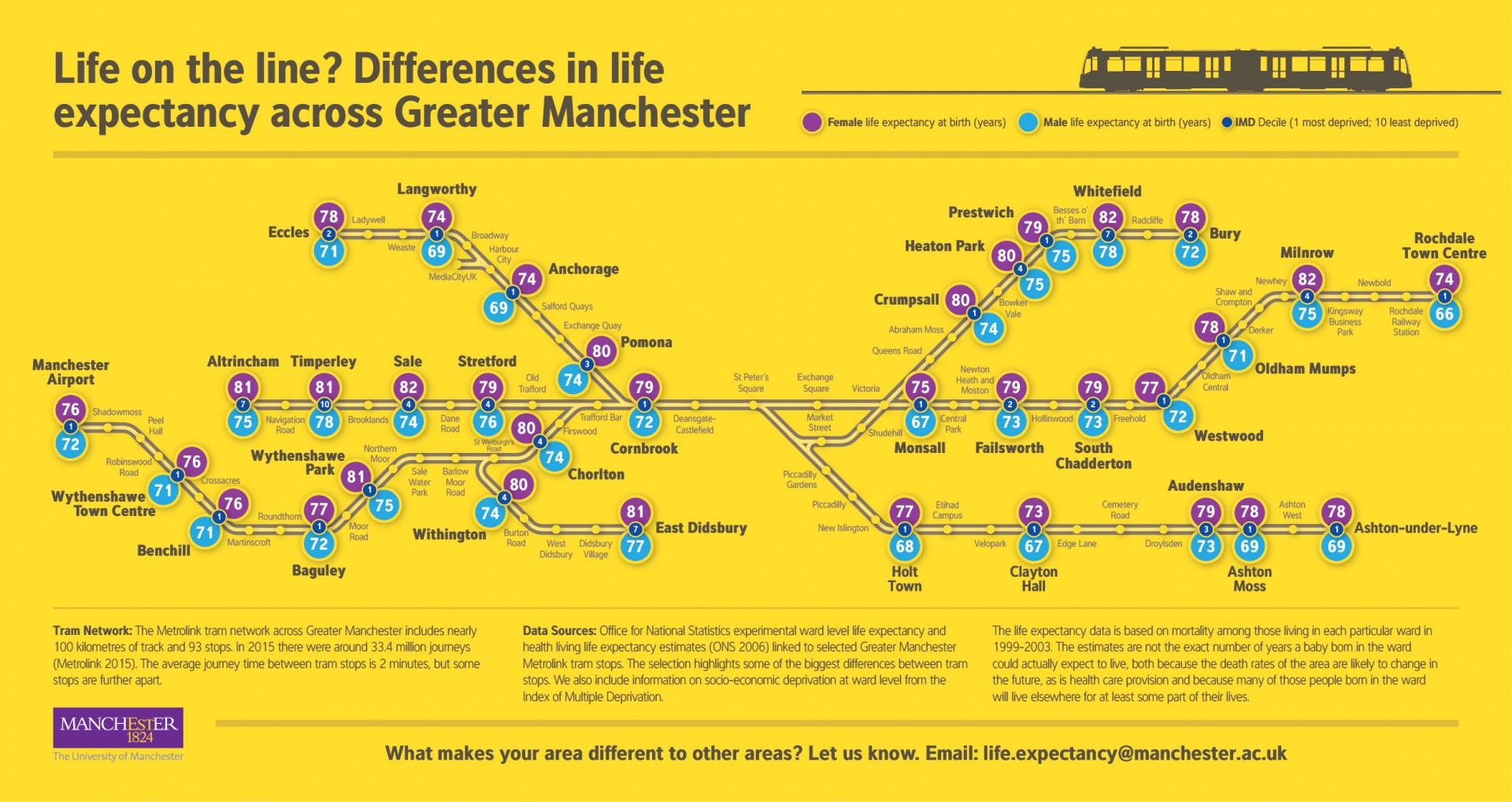
 Greater Manchester’s Metrolink used to map life expectancy

An academic from The University of Manchester has created a map based on the region’s Metrolink tram network, which has revealed the striking differences in life expectancy across Greater Manchester.

The map shows estimated differences of more than a decade in life expectancy across Greater Manchester. For example, the journey by tram from Timperley to stops in central Manchester takes around 30 minutes, but the estimated difference in life expectancy between the areas could be more than 10 years, or around a year for every 3 minutes of the journey.

The tram journey from Timperley to Rochdale may take around 75 minutes, but the data suggests a difference in life expectancy between the areas could be up to 12 years.

Greater Manchester is in the ten areas with the lowest life expectancy in the UK. Dr Kingsley Purdam, part of the University’s Manchester Institute for Collaborative Research on Ageing said the map highlighted the strong association between the economic deprivation level of an area and life expectancy.

"The routes of the tram network provide a way of engaging the public in the health story of Greater Manchester, by linking the tram stops and journey times with ward-level life expectancy estimates," said Dr. Purdam. "The estimates are based on Office for National Statistics data on the mortality. They are not the exact number of years a baby born in the ward could actually expect to live, death rates and health care provision are likely to change in the future, and many of those born in the ward will live elsewhere for at least some part of their lives. However, the data does highlight the underlying inequalities in life expectancy."
On average people in Manchester have a life expectancy at birth of 75 years, compared to 83 years in East Dorset - the area with the highest life expectancy in the UK. This compares to the overall UK average of 82 years.

There is also a difference of 3 years in life expectancy between men and women in the UK, but in the metropolitan area of Manchester, the difference is 5 years, with the city having the lowest life expectancy of any area in the UK for women. These differences are also evident in terms of how long people are estimated to live in good health.
A range of often interrelated factors are linked to lower life expectancy such as low income, employment status, the local environment, access to health care, smoking and alcohol consumption, diet, exercise, social status and social isolation. The most common causes of death in the UK are from: circulatory diseases (including heart and stroke), cancer, respiratory diseases and dementia. Perhaps most striking is the economic gradient in differences in life expectancy across Greater Manchester and the UK as a whole.

Compared to the UK, life expectancy across most of Greater Manchester is low, and there are considerable differences across the area at the local level. Whilst people are living longer the gap between certain populations is growing. The differences are a human rights issue. The lost years of life not only have an impact on the individuals, but also on the families and friends they leave behind.

We hope this map can highlight the issue to the public and health professionals. The inequalities are a real challenge for the delivery of the new devolved health budget and services in Greater Manchester.
Dr Kingsley Purdam

quinta-feira, 6 de outubro de 2016

Estamos atingindo o limite máximo de vida

Humans unlikely to ever live beyond the age of 125, says study

Sky News
Humans are unlikely ever to live beyond the age of 125, according to researchers who say we are already close to our limit.
The scientists studied survival data dating back to 1900 from more than 40 countries.
They found evidence of increasing average life expectancy, meaning that over time more people lived to a ripe old age.
Babies born in the US today can expect to live to just below 79, compared to 47 in 1900.
But the same study highlighted how unusual it was to live beyond 100, regardless of the year in which people were born.
The team calculated that 125 was likely to be the absolute limit of human lifespan due to genetic factors.
Lead researcher Professor Jan Vig, from the Albert Einstein College of Medicine in New York City, said: "Demographers as well as biologists have contended there is no reason to think that the on-going increase in maximum lifespan will end soon.
"But our data strongly suggests that it has already been attained and that this happened in the 1990s.
"Further progress against infectious and chronic diseases may continue boosting average life expectancy, but not maximum lifespan."
The study, published in the journal Nature, focused on people living to 110 or older between 1968 and 2006 in the US, UK, France and Japan.
Age at death for these super-centenarians rose rapidly between the 1970s and early 1990s but reached a plateau in the mid-1990s.
The oldest verified person on record was French woman Jeanne Calment (1875-1997), who lived to be 122 years and 164 days.
She is followed by Sarah Knauss of the United States, who was born in 1880 and lived for 119 years and 97 days.
The oldest living person in the world right now is Italian Emma Morano, who was born in November 1899 and is presently 116 years and 312 days old.
With a top age so far of 122, humans are not the longest-living land animals on Earth.
That honour falls to Galapagos giant tortoises, which have been known to live to 152.

domingo, 26 de junho de 2016

Diante do espelho: Não acredito que já estou com 80 anos!

Elderly People Look At Their Younger Reflections In This Beautiful Photo Series By Tom Hussey: ‘Reflections of The Past’ is an award-winning photo series by commercial advertising photographer Tom Hussey. The photographs show an elderly person looking pensively at the reflection of his/her younger self in the mirror. Hussey was inspired by a World War II veteran who said “I can’t believe I’m going to be 80. I feel like […]
Muito boa matéria e fotos! Adorei principalmente as fotos de numero 1, 4, 12 e 14. 
Realmente, sentir-se mais jovem não significa negar a velhice como querem alguns. De fato, contribui para a velhice bem sucedida (plasticidade comportamental). Na minha pesquisa pro doutorado, aqueles que se sentiam mais jovens do que eram possuíam maior percepção de controle.